
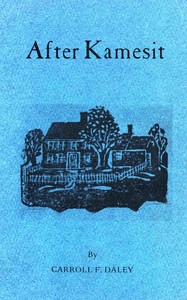
After Kamesit : A chronical of a local habitation and some names, with notes,…
I picked up 'After Kamesit' expecting a standard local history. What I got was something far more intriguing and layered. Carroll F. Daley's book presents itself as a simple record—'a chronicle of a local habitation and some names'—but that's just the surface.
The Story
The book is structured as a document trying to make sense of Kamesit, a place that seems to have simply ended. Daley lists names, plots of land, and old records with a historian's care. But woven into this dry catalog are personal notes, observations, and questions. We never see Kamesit thriving; we only see its outline after the people are gone. The 'story' is the act of reconstruction itself. Who were these people? Why did they leave? What remains when a community disperses? The central thread is the narrator's (presumably Daley's) quiet obsession with filling in the blanks, making the empty maps and silent houses speak again.
Why You Should Read It
This book got under my skin. It's not a fast-paced narrative, but it creates a powerful mood. The genius is in the contrast between the formal chronicle and the informal, almost lonely notes in the margins. You start feeling the weight of all those missing voices. It makes you think about your own town, your own street, and all the forgotten stories underfoot. Daley doesn't give easy answers about Kamesit's fate, which is frustrating in the best way—it feels true to life. History is often about the loud events; this book is about the quiet aftermath. It’s a meditation on memory and place that’s surprisingly moving.
Final Verdict
This isn't for everyone. If you need a driving plot and clear resolutions, you might find it too sparse. But if you're a patient reader who loves local history, ghost towns, or books that feel like artifacts themselves, 'After Kamesit' is a small, strange treasure. It's perfect for a rainy afternoon when you're feeling contemplative. Think of it as the literary equivalent of browsing a dusty archive and finding a photo album with half the pictures missing—your imagination has to do the rest. A unique, haunting read for anyone fascinated by the echoes left behind when people move on.
This title is part of the public domain archive. You are welcome to share this with anyone.
Thomas Robinson
6 days agoSimply put, the pacing is just right, keeping you engaged. Exactly what I needed.
Patricia Thompson
1 year agoClear and concise.








Lisa Miller
1 year agoThis is one of those stories where the narrative structure is incredibly compelling. Worth every second.