
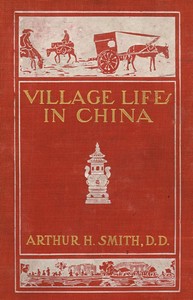
Village Life in China: A Study in Sociology by Arthur H. Smith
Forget dry history textbooks. Village Life in China is something else entirely. It's a collection of observations, stories, and social analysis written by Arthur H. Smith, an American missionary who spent nearly 50 years in rural Shandong province in the late 1800s. There's no traditional plot. Instead, Smith acts as our guide, taking us on a tour of a world that was, even then, rapidly changing.
The Story
The book isn't about one story; it's about thousands of small ones that make up daily existence. Smith structures it like a sociological field guide. He shows us how villages were organized, how families operated under strict Confucian rules, and how farmers battled famine and flood. He explains complex social contracts, like how neighbors would band together for protection or how village elders settled disputes. We see the exhausting cycle of planting and harvest, the elaborate rituals around births and funerals, and the quiet struggles of poverty. The "narrative" is the slow, grinding, and resilient rhythm of life itself, far from the imperial courts and cities we usually read about.
Why You Should Read It
You should read this for the incredible, ground-level detail. Smith doesn't just say "life was hard"; he describes the exact weight of a water bucket carried for miles or the specific anxiety of watching the sky for rain. His perspective is a double-edged sword. As a Western missionary, his views on Chinese culture are often biased and paternalistic—you have to read with that critical eye. But because he lived there so long, he also captures moments of genuine humanity, humor, and ingenuity that a short-term visitor would miss. The value is in seeing this society from the inside out, through the eyes of a permanent outsider. It makes you think about how any culture looks when viewed from another angle.
Final Verdict
This book is perfect for curious readers who love social history, anthropology, or just great storytelling about everyday people. It's for anyone who enjoyed books like The Good Earth but wants the non-fiction, eyewitness account. If you can handle the occasional outdated attitude from the author and focus on the rich cultural portrait he paints, you'll be rewarded. It's not a light read, but it's a profoundly illuminating one. You'll close it feeling like you've peeked through a keyhole into a vanished world.
Legal analysis indicates this work is in the public domain. Feel free to use it for personal or commercial purposes.
Nancy Clark
1 year agoSolid story.





Steven Garcia
1 year agoThanks for the recommendation.