
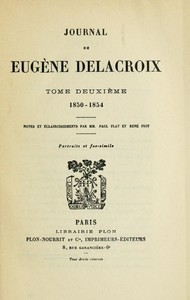
Journal de Eugène Delacroix, Tome 2 (de 3) by Eugène Delacroix
This isn't a novel with a plot in the traditional sense. Eugène Delacroix's Journal, Volume 2 is a direct line to the painter's private thoughts from 1847 to 1853. We follow him through his daily life in Paris and at his country retreat. He details his struggles with chronic illness, his opinions on everything from music and literature to politics, and his complex relationships with friends and fellow artists. The 'story' is the ongoing drama of creation: the grind of securing commissions, the agony of self-doubt, and the rare moments of triumph when a painting finally comes together.
The Story
The book opens with Delacroix as an established master, but one who feels the world changing around him. He's working on huge public projects like the ceiling of the Louvre's Apollo Gallery. The journal entries are his anchor. He writes about visits to the opera, arguments with critics, and long walks where he observes light and color. We see him preparing for the 1855 World's Fair, a major career moment. Through it all, his poor health—a persistent throat condition—casts a long shadow, making every painting a physical battle. The narrative is the quiet, relentless pursuit of his craft against the ticking clock of his own body.
Why You Should Read It
I loved this because it completely shatters the myth of the effortless artistic genius. Delacroix is brilliant, but he's also petty, proud, insecure, and wonderfully observant. Reading his notes on how to mix a certain green or why he admires Rubens feels like taking a masterclass. His musings on Mozart or his irritation at a bad performance are hilarious and human. You get the sense of a mind constantly churning, finding inspiration not just in grand themes, but in the rustle of leaves or the face of a passerby. It makes his famous paintings, like Liberty Leading the People, feel even more powerful because you know the real, tired man behind them.
Final Verdict
This is perfect for anyone curious about the creative process, not just art lovers. If you've ever worked on a project that consumed you, you'll relate to Delacroix's frustrations and small victories. History buffs will adore the firsthand, gossipy account of 19th-century Parisian culture. It's a slow, reflective read—best enjoyed in small chunks, like having a coffee with a fascinating, complicated friend. Don't expect a neat story with an ending; expect a privileged, intimate look into a great mind at work.
This work has been identified as being free of known copyright restrictions. It is available for public use and education.





Jessica Davis
3 months agoSurprisingly enough, the depth of research presented here is truly commendable. Worth every second.