
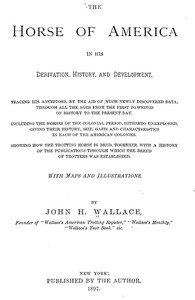
The Horse of America in His Derivation, History, and Development by Wallace
Published in 1897, John Hankins Wallace's The Horse of America in His Derivation, History, and Development is not your typical animal husbandry manual. It's a passionate, detailed argument wrapped in a historical survey. Wallace, a respected livestock expert, sets out to tell the complete story of the horse in North America, but he quickly zeroes in on the period's biggest debate: the origin of the herds that transformed Native cultures and the frontier.
The Story
Wallace structures his book like a lawyer building a case. He first paints a picture of the horse's biology and its ancient ancestors. Then, he gets to the heart of the matter. He systematically examines and dismantles the popular theories of his time, like the idea that horses survived from prehistoric times or arrived via a lost land bridge. His prime target is the belief that all horses came from the few brought by Spanish conquistadors. Using logic, early traveler accounts, and observations of herd behavior, Wallace argues this is impossible. He presents his own theory: that horses arrived from multiple sources over time, including through Russian traders in the Pacific Northwest and via diffusion across the continent. The book is his evidence-filled manifesto for this idea.
Why You Should Read It
What makes this old book compelling is Wallace's voice. You can feel his frustration with what he sees as lazy thinking. He's not a detached academic; he's a man on a mission to set the record straight, citing pioneers and explorers like personal witnesses. While some of his science is dated, the core of the book—a detailed look at how the horse spread across the West—is fascinating. You get a real sense of how this animal changed everything: warfare, hunting, trade, and travel. Reading it lets you peer into the mind of a 19th-century expert and appreciate the detective work that went into understanding history before modern archaeology.
Final Verdict
This is a niche read, but a rewarding one. It's perfect for history buffs who love primary sources, anyone interested in the American West, or readers who enjoy seeing how historical debates were fought. It's not a light novel—it's dense with details—but Wallace's forceful personality and clear passion for the subject carry you through. Think of it as a time capsule of scientific argument, offering a unique and surprisingly engaging perspective on an animal that helped shape a nation.
No rights are reserved for this publication. Share knowledge freely with the world.
Lucas Rodriguez
1 year agoEnjoyed every page.
Aiden Thomas
1 year agoGood quality content.
Matthew Harris
1 year agoIf you enjoy this genre, the plot twists are genuinely surprising. Exceeded all my expectations.
Noah King
1 year agoFrom the very first page, the author's voice is distinct and makes complex topics easy to digest. I will read more from this author.









Amanda Scott
9 months agoRecommended.